1. General
Dutch Betting Explained – How IdealBet Calculates the Bet
Published: 2026-09-23
Dutch Betting Explained – How IdealBet Calculates the Bet
Picking a horse and calculating a bet are two different problems.
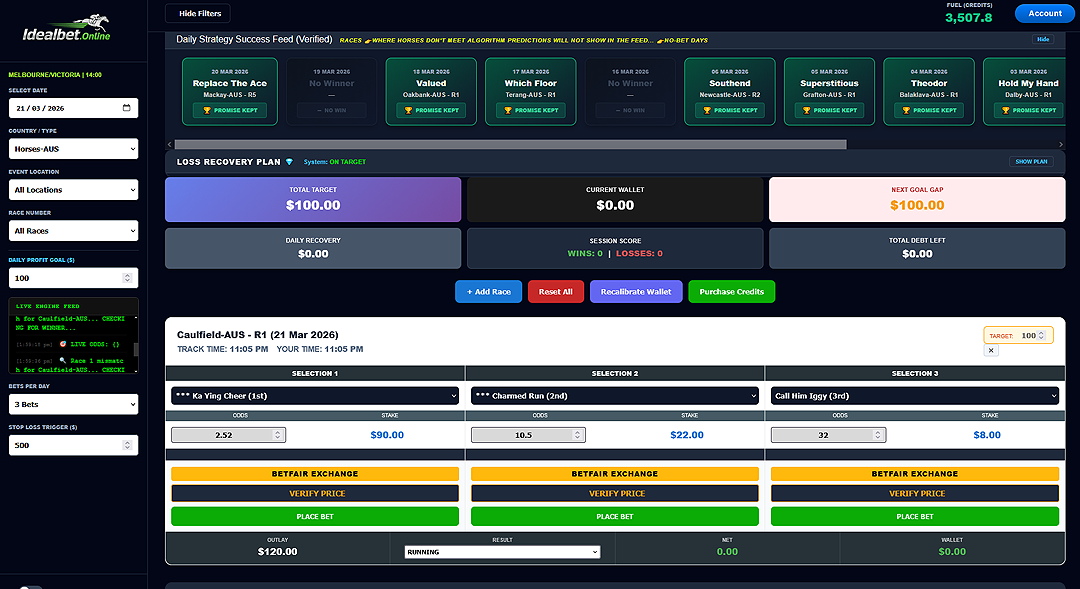
IdealBet approaches horse racing from both directions. First, the system identifies the strongest contenders for a race. Then it determines how those selections can be wagered using the available market odds.
When more than one horse qualifies, Dutch Betting provides a mathematical way of distributing the stake across those selections.
What Is Dutch Betting?
Dutch Betting involves backing more than one selection in the same market and dividing the total stake according to the odds available for each selection.
Rather than placing the same amount on every horse, the wager is calculated so the individual stakes reflect their different prices.
The objective is to construct a combined position across the selected contenders rather than relying on a single horse.
Why the Odds Change the Calculation
Consider two horses priced at very different odds.
Placing an identical dollar amount on both horses would produce very different returns depending on which horse won.
Dutch Betting accounts for those differences by calculating the stake allocated to each selection according to its market price.
Change the odds and the required stake distribution changes with them.
IdealBet Starts With the Contenders
IdealBet does not simply take several horses from a race and divide money between them.
The selection process comes first.
Depending on the race analysis, IdealBet may identify one, two or three predicted contenders. The betting calculation then works with those selections and their available odds.
This creates several possible prediction structures:
- P1 — one selected horse
- P1 + P2 — two selected horses
- P1 + P3 — two selected horses
- P2 + P3 — two selected horses
- P1 + P2 + P3 — three selected horses
Single Selection Versus Dutch Betting
When only one horse is selected, there is nothing to Dutch. The calculation applies to that individual selection.
When two or three contenders are selected, the calculation can distribute the required outlay across those horses according to their respective odds.
This distinction is important because the number of predicted horses can change from race to race.
The Calculation Happens Before the Race
The purpose of the calculator is to establish the betting position using information available before the race is run.
The selections, market odds and required stakes form the betting decision. The subsequent race result then determines the return and resulting profit or loss.
This allows the calculation and the eventual outcome to become part of the historical record.
Why Bet Calculation Matters
A horse racing prediction tells you which horse or horses have been identified.
It does not necessarily tell you how much to wager on each one.
That distinction becomes particularly important when several contenders have different market odds.
IdealBet combines these two stages:
Find the contenders — then calculate exactly how to bet them.
From Calculation to Historical Proof
Once a race has finished, its outcome becomes part of the performance record.
IdealBet's Historical Performance Ledger records the selections alongside the odds, result, betting outlay, return and resulting profit or loss.
That means the betting calculation is not viewed in isolation. Its eventual result can be examined as part of the broader historical performance.
See the Calculation in Action
Dutch Betting is fundamentally a mathematical process. The easiest way to understand it is to see the selections, odds and calculated stakes working together.
IdealBet Online combines horse racing predictions, real market odds and calculated betting positions within one system.
See how IdealBet finds the contenders — then calculates exactly how to bet them.