1. General
Horse Racing Analytics vs Traditional Horse Racing Tips
Published: 2026-09-23
Horse Racing Analytics vs Traditional Horse Racing Tips
A traditional horse racing tip usually answers one question: which horse should I back?
That can be useful, but it leaves several other questions unanswered. Why was the horse selected? Are there other serious contenders? What are the available odds? How much should be wagered? And what does the long-term record show?
Horse racing analytics takes a broader approach by treating the selection as one part of the overall betting decision.
What Is a Traditional Horse Racing Tip?
At its simplest, a racing tip identifies a horse expected to perform strongly in a particular race.
The selection might be based on form, track conditions, previous performances, market information or the judgement of the person making the prediction.
But the tip itself generally tells you very little about how the resulting bet should be structured.
Horse Racing Analytics Adds Another Layer
Analytics attempts to turn available racing information into measurable decisions.
Instead of stopping when a contender has been identified, an analytical approach can consider:
- The strongest predicted contenders
- The number of selections qualifying for the race
- Available market odds
- Stake calculations
- Potential returns
- Historical win and loss data
- Running profit and loss
The prediction remains important, but it becomes part of a larger calculation.
One Race Can Have More Than One Contender
Horse racing does not always produce a situation where one horse stands clearly above every other runner.
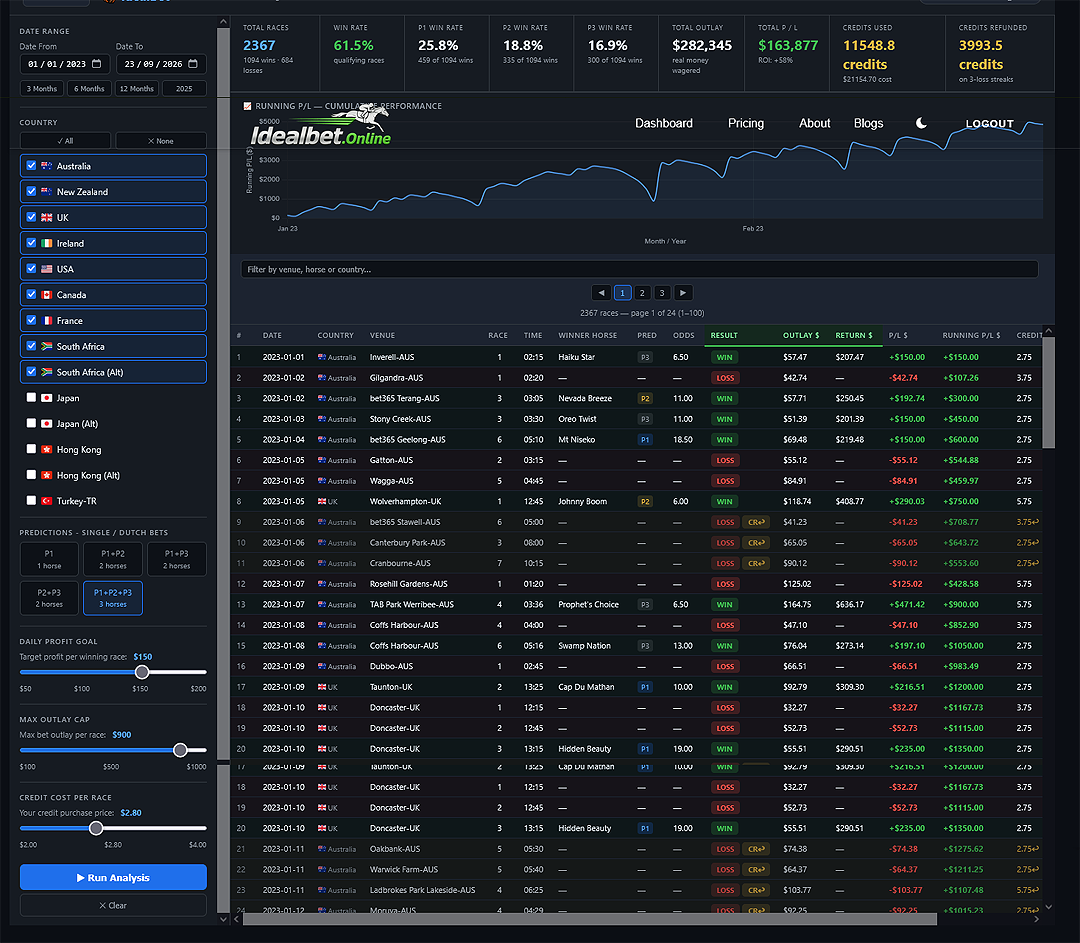
IdealBet's analysis can identify one, two or three contenders depending on the race.
These are ranked as P1, P2 and P3 predictions, allowing the betting calculation to respond to the particular selections identified for that race.
When multiple horses qualify, Dutch Betting calculations can then be used to determine how the total stake is distributed across the selected contenders.
Odds Are Part of the Decision
A horse may appear attractive as a racing selection while being considerably less attractive at a particular market price.
This is why betting odds cannot be separated from betting mathematics.
The same selections at different prices can require different stake calculations and produce different potential returns.
IdealBet therefore combines the predicted contenders with available market odds before calculating the betting position.
Analytics Does Not Remove Uncertainty
No amount of racing data can make the outcome of a horse race certain.
Unexpected pace, interference, track conditions, rider decisions and the performance of the horses themselves can all affect the result.
The purpose of analytics is not to pretend that uncertainty disappears. It is to make the decision process more structured and measurable.
The Historical Record Matters
An analytical system should ultimately be judged against what happened after its decisions were made.
That requires more than displaying successful predictions.
IdealBet's Historical Performance Ledger records winners and losers alongside predictions, odds, betting outlays, returns and running profit or loss.
This provides a historical record against which the analytical process can be examined.
Tips Tell You What. Analytics Helps Explain How.
There is an important distinction between identifying a horse and constructing the bet.
IdealBet combines both stages:
We find the contenders — then calculate exactly how to bet them.
The objective is to move beyond an isolated racing tip towards a structured process involving predictions, real market odds, betting calculations and measurable historical results.
Horse racing tips identify the opportunity. Horse racing analytics provides the framework for examining it.