1. General
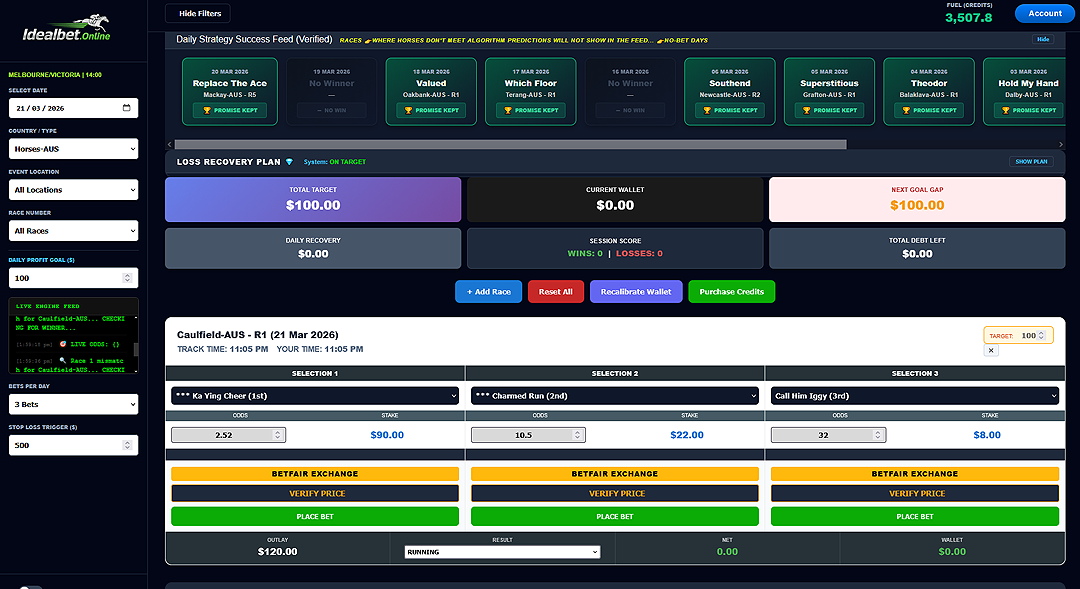
How IdealBet Selects 1, 2 or 3 Horses in a Race
Published: 2026-09-25
How IdealBet Selects 1, 2 or 3 Horses in a Race
Most traditional horse racing tips are presented in a familiar way: one race, one horse, one selection.
IdealBet approaches the problem differently.
Instead of beginning with the assumption that every race must produce a single selection, IdealBet analyses the available racing data using mathematical algorithms designed to identify the strongest qualifying contenders.
Sometimes the analysis identifies one horse. Sometimes it identifies two. Sometimes three.
Why Not Simply Pick One Horse?
A horse race contains multiple competitors and multiple variables. Forcing every race into a single-selection format can discard information identified during the analysis.
IdealBet therefore allows its selection process to produce up to three qualifying contenders.
The objective is not to manufacture three selections. It is to retain the contenders that satisfy the system's selection logic.
Understanding P1, P2 and P3
IdealBet identifies its predicted contenders as P1, P2 and P3.
P1 is the first-ranked predicted contender. P2 is the second-ranked contender when one qualifies, and P3 is the third-ranked contender when the analysis supports a third selection.
These labels allow the prediction to be recorded consistently before the race and later compared with the actual result.
One Selection Is Still a Complete Prediction
If only one horse satisfies the relevant selection criteria, IdealBet does not need to add another horse simply to create a larger group.
That race can remain a single-selection prediction.
Likewise, when the analysis identifies two or three qualifying contenders, those additional selections can form part of the published prediction.
The Selection Comes Before the Betting Calculation
There are two separate questions:
Which horses qualify as predicted contenders?
and:
How should the available stake be distributed across those contenders?
The selection algorithms address the first question. The betting calculation addresses the second.
When multiple contenders are selected, Dutch Betting can then calculate the appropriate stake distribution using the available market odds.
Why Market Odds Still Matter
Two races can each contain three predicted contenders but require very different betting calculations.
A contender at short odds and another at considerably longer odds should not automatically receive identical stakes.
That is why IdealBet separates contender identification from the subsequent Dutch Betting calculation.
Every Prediction Can Be Checked Afterwards
The important part is not simply displaying P1, P2 and P3 before a race.
The prediction must eventually meet the actual race result.
IdealBet's Historical Performance Grid records which predicted position produced the winner — P1, P2 or P3 — together with the odds, result, outlay, return and resulting profit or loss.
The Algorithm Selects — The Historical Record Tests It
No horse racing algorithm can remove uncertainty from racing.
What can be measured is how its selections actually performed.
That is why IdealBet combines pre-race selections with a historical record containing both successful and unsuccessful predictions.
The selection is made before the race. The result determines whether it was right.